


WhatsApp AI Chatbots in 2026: Are They Banned? The Real Story CEOs Need to Know
WhatsApp has not banned business AI chatbots in 2026. Meta restricts general-purpose AI assistants, while customer service, sales and booking bots can still operate under the WhatsApp Business terms.
 Jarkko Oksanen · Co-founder & CTO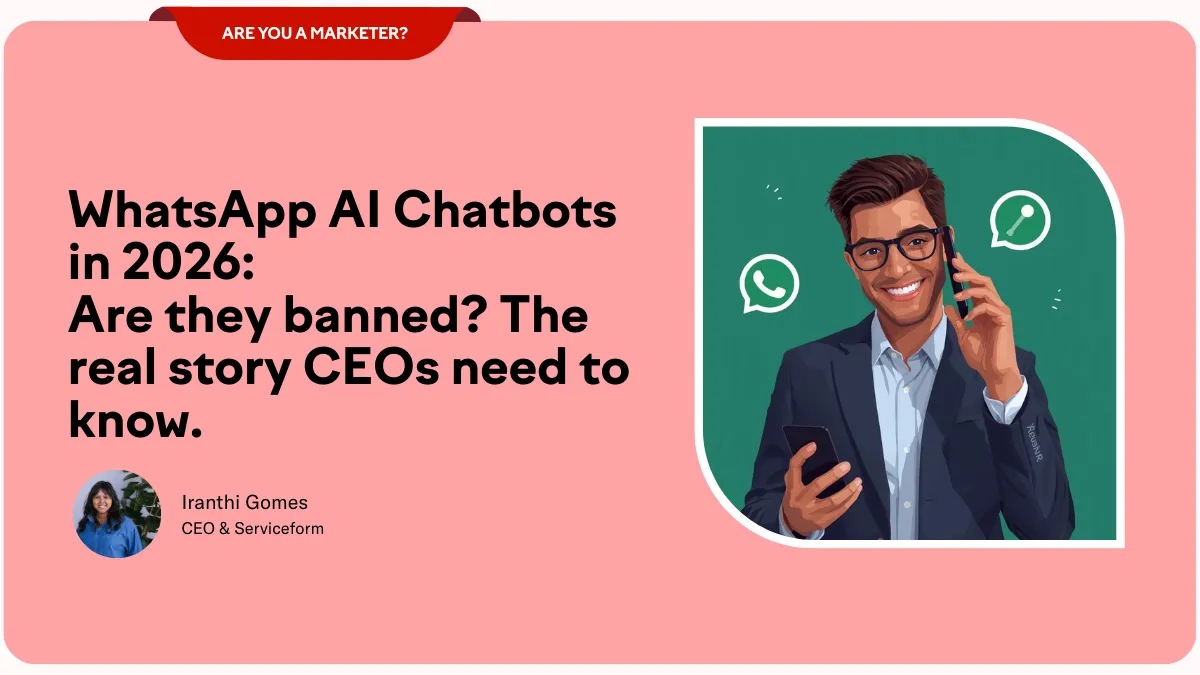
WhatsApp has not banned AI chatbots for customer service, sales or bookings in 2026. Meta’s rules target AI providers that use WhatsApp to distribute a general-purpose AI assistant as the main product. A business can still use an AI provider as a contracted service provider, subject to Meta’s terms, messaging policies and data-use restrictions.
That is the answer most CEOs need. The practical question is not “does this bot use AI?” It is “what service is the customer receiving, and what happens to the conversation data?”
This guide reflects Meta’s published terms available on August 16, 2026. Policies can change, so check the primary sources before launch or after a material product change.
Did WhatsApp ban AI chatbots in 2026?
No. Meta did not issue a blanket ban on AI chatbots.
The WhatsApp Business Solution Terms restrict an “AI Provider” from using WhatsApp to make AI technology available when that technology is the primary, rather than incidental or ancillary, functionality.
In plain English:
- A retailer using AI to answer product questions is a business using AI as a tool.
- A dealership using AI to find cars and book test drives is a business using AI as a tool.
- A hotel using AI to answer guest questions is a business using AI as a tool.
- A company distributing a general-purpose “ask me anything” assistant through WhatsApp is offering AI as the product.
Meta’s own product direction reinforces the distinction. Its WhatsApp Business Platform documentation describes AI-powered agents that can use business knowledge, connect to external APIs, book appointments and hand conversations to people. Meta also promotes business AI on WhatsApp for customer conversations.
What changed for general-purpose AI assistants?
The restriction took effect in January 2026 and affected services that used WhatsApp as a distribution channel for a general-purpose assistant. That is different from a company using AI inside a customer journey.
Meta’s current terms also contain an important geographic qualification. As published on August 16, 2026, the AI-provider clause says such technologies may be made available to users with phone numbers registered in the European Economic Area or Brazil. Do not rely on old summaries that describe only an Italy exception or say Brazil is excluded. Read the current clause for the markets you serve.
This geographic exception does not remove the other WhatsApp Business rules. Messaging consent, data handling, approved use cases and local law still matter.
Which WhatsApp AI chatbot use cases are generally allowed?
For a normal business, the permitted pattern is AI acting as a tool to deliver the company’s own product or service. Common examples include:
- answering customer service questions
- recommending products from the company’s catalogue
- qualifying a sales enquiry
- booking a test drive, viewing or appointment
- checking an order or delivery status
- routing a conversation to the right employee
- drafting a response for a human agent
If that is what you want to build, see Serviceform’s WhatsApp AI product and our practical guide to using WhatsApp with AI for business.
Calling a use case “customer service” does not automatically make the implementation compliant. The setup must still follow Meta’s terms and applicable privacy law.
Which WhatsApp AI use cases are restricted?
The highest-risk pattern is using WhatsApp as the place where the public accesses an AI model or general-purpose assistant.
Examples include:
- selling access to a general-purpose AI assistant through WhatsApp
- offering an AI companion whose main function is open-ended conversation
- using WhatsApp as the primary interface for an AI model product
- allowing WhatsApp Business Solution Data to train or improve shared AI models
- repurposing conversation data beyond the contracted business service
The label on the product does not decide the issue. Meta says it determines whether AI is the primary functionality.
What do Meta’s data rules mean for businesses?
This is where a sensible AI use case can still go wrong.
Under the current WhatsApp Business Solution Terms, a business may retain an AI provider as a third-party service provider. However, the terms restrict the use of Business Solution Data to create, develop, train or improve AI models.
Meta’s clause includes a narrow allowance for fine-tuning an AI model for the business’s exclusive use, provided the data is not used to create, develop, train or improve other AI models. That wording is specific. Ask your provider to explain the actual data flow, retention and model-training settings in writing.
Before launch, confirm:
- Which WhatsApp data is processed?
- Which processors and subprocessors can access it?
- Is any conversation data retained, and for how long?
- Can the provider use the data to train a shared model?
- Where is the data hosted?
- How can a customer reach a person?
- How are consent, templates and outbound messaging handled?
Do not accept a vague answer such as “we are GDPR compliant.” You need to know what happens to the data.
How does a business WhatsApp AI chatbot work?
A typical customer-service flow looks like this:
- A customer sends a message to the business’s WhatsApp number.
- The WhatsApp Business Platform sends the event to the business or its contracted provider.
- The AI uses approved business information, such as FAQs, inventory or order data, to prepare a response.
- The bot answers, completes an approved action or hands the conversation to a person.
- The business applies its retention, security and access controls.
The bot should be grounded in your business data, limited to your use case and designed for human handoff. It should not behave like an unrestricted public AI assistant merely because the conversation happens on your number.
A CEO’s WhatsApp AI checklist
1. Define the business purpose
Write one sentence explaining the customer outcome. “Book service appointments” is clear. “Give users access to our AI” deserves closer legal and policy review.
2. Use the official WhatsApp Business Platform
Build on Meta’s official platform or work with a provider that does. Avoid unofficial automation that imitates a consumer WhatsApp client.
3. Review the current Meta terms
Check the Business Solution Terms and Business Messaging Policy for every market you serve. Save the review date.
4. Get data-use commitments in writing
Your agreement should cover processing purpose, retention, hosting, subprocessors, security, deletion and model training.
5. Keep a human handoff
Customers need a clear route to a person when the AI cannot answer, when the request is sensitive or when the customer asks for one.
6. Monitor the live assistant
Review failed answers, escalations and policy changes. Compliance is an operating process, not a badge added on launch day.
Frequently asked questions
Are WhatsApp AI chatbots banned in 2026?
No. WhatsApp still supports AI for business customer service, sales and operational use cases. Meta restricts AI providers from distributing AI as the primary product through WhatsApp, subject to the geographic wording in its current terms.
Can a business use ChatGPT or another AI model with WhatsApp?
A business may retain an AI provider as a third-party service provider under Meta’s terms. The provider must serve the business’s use case, and the implementation must follow Meta’s restrictions on Business Solution Data and AI model training.
Can a WhatsApp AI chatbot answer customer questions?
Yes, this is a standard business use case. Meta’s own WhatsApp materials describe AI agents that answer questions, use business knowledge, qualify leads and take actions such as booking appointments.
Can a WhatsApp AI chatbot book appointments and qualify leads?
Yes, when those actions support the business’s own customer journey and the implementation follows WhatsApp’s messaging, consent and data rules.
Can WhatsApp conversations be used to train an AI model?
Meta’s terms restrict using Business Solution Data to create, develop, train or improve AI models. They describe a limited exception for fine-tuning a model for the business’s exclusive use, provided the data does not improve other models. Confirm the exact setup with your provider and legal adviser.
Do the same WhatsApp AI rules apply in every country?
Not necessarily. Meta’s terms published on August 16, 2026 include specific wording for users with EEA or Brazil phone numbers, and local privacy or competition law may also apply. Check the current terms for your markets.
What is the safest way to add AI to WhatsApp?
Use the official WhatsApp Business Platform, keep the bot focused on your business, control how conversation data is processed, provide human handoff and review the current policies. Our WhatsApp AI for business guide explains the operational setup.
Primary Meta sources
- WhatsApp Business Solution Terms
- WhatsApp Business Messaging Policy
- WhatsApp Business Platform and Cloud API documentation
- WhatsApp for Business: business AI on WhatsApp
The bottom line
WhatsApp did not ban business AI chatbots. It drew a line between a business using AI to serve its customers and an AI provider using WhatsApp to distribute AI as the product.
If you are automating support, sales or bookings, start with the business purpose, official platform and data controls. Then verify the current Meta terms for your markets. If you want to see what that looks like in practice, explore Serviceform for WhatsApp.
This article is a practical policy summary, not legal advice.