AI Search for Car Dealerships: A Complete Buyer's Guide
How AI vehicle search works, how it compares with filters and chatbots, the 7 features to look for, what it costs, and how to measure ROI before you buy.
 Jonathan Francis · Growth Marketer

Imagine a customer visiting your dealership website looking for a reliable automatic SUV under €25,000, with enough space for their family of five and a dog.
They know what they need. They have a budget, a clear idea of how they’ll use the car, and they’re ready to explore their options.
But your website asks them to choose a make, model, body type, transmission, fuel type, and several other filters before they can see suitable vehicles. What if they don’t know which SUV models would work for their family?
This is where AI search for car dealerships offers a different approach. Instead of making customers figure out which filters to select, AI-powered vehicle search lets them describe what they’re looking for in everyday language and discover relevant cars from your available inventory.
Traditional vehicle filters still have their place. But they don’t always reflect how people actually shop for cars.
In this guide, we’ll explain how AI vehicle search works, how it compares with traditional search and chatbots, what features matter most, and how to evaluate the costs and potential return on investment.
What is AI search for car dealerships?
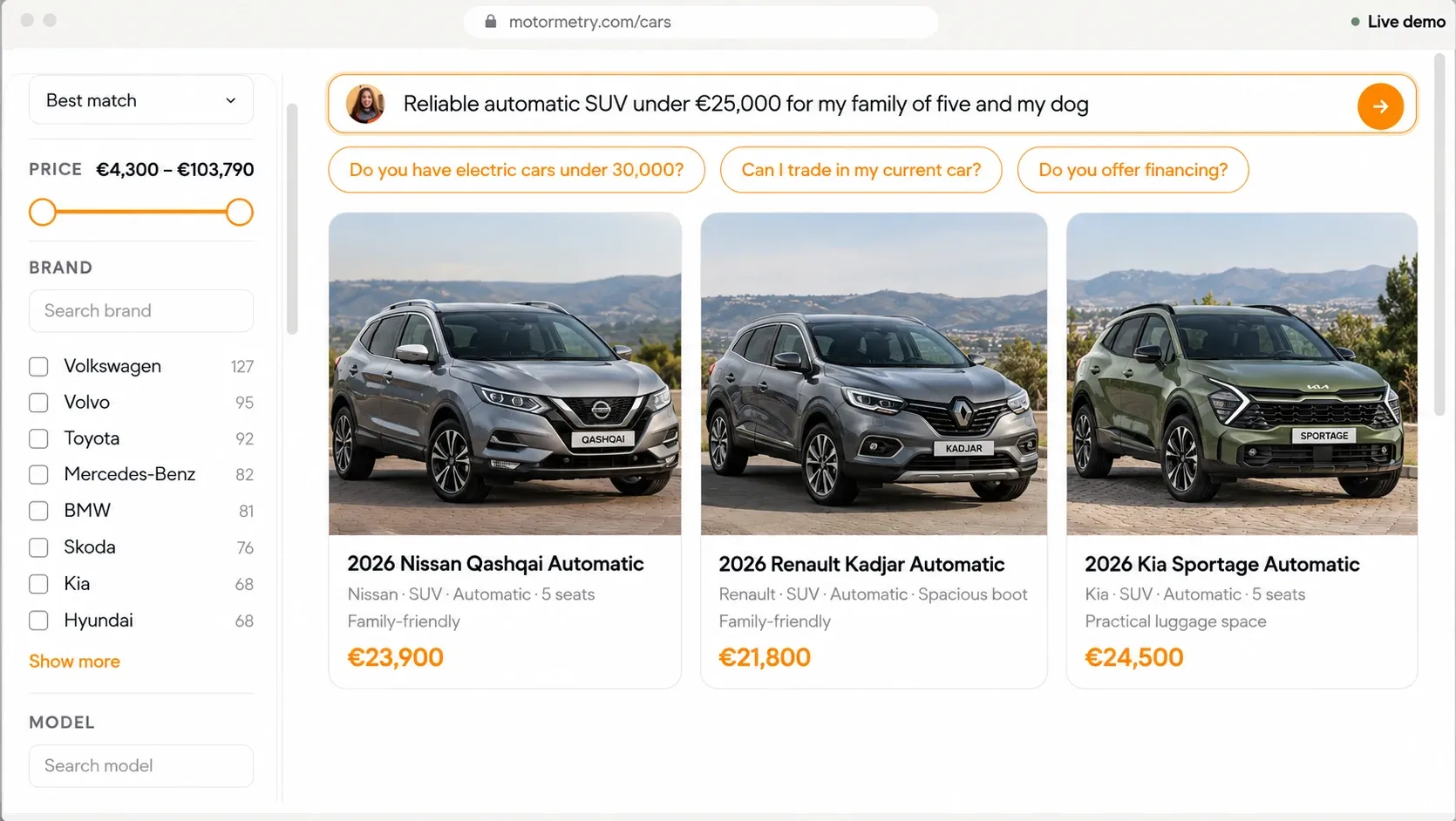
AI search for car dealerships is technology that helps website visitors find relevant vehicles by describing what they need in natural language, rather than relying entirely on predefined filters or exact keywords.
For example, instead of selecting several filters, a customer could type:
- “An electric family car with at least 400 km of range.”
- “A reliable automatic SUV under €25,000.”
- “A seven-seater with enough room for luggage.”
- “A fuel-efficient car for my daily commute.”
The system interprets the customer’s request, identifies relevant requirements, and searches the dealership’s connected inventory for suitable vehicles.
The goal is simple: help customers find vehicles that match their needs without requiring them to understand every technical specification first.
What is natural language vehicle search?
Natural language vehicle search allows people to search the way they normally speak or write. A customer might say they need a car for a growing family, rather than searching for a specific SUV model.
AI can help translate that description into searchable requirements, such as vehicle size, seating capacity, body type, transmission, or budget.
The results still need to be grounded in the dealership’s actual vehicle information. AI should not invent specifications or assume that a particular car has features missing from the inventory data.
How is AI search different from traditional keyword search?
Traditional keyword search typically looks for particular words or phrases, such as “Toyota Corolla” or “electric SUV.” AI-powered search can interpret the meaning behind a longer request and match several requirements together.
Importantly, AI search doesn’t have to be a chatbot. Sometimes, the best AI response isn’t a conversation. It’s a relevant set of cars displayed immediately.
The primary job of vehicle search is to help someone find what they’re looking for. Additional explanations and guidance can come afterward, when they’re useful.
Why traditional vehicle search doesn’t always match how people buy cars
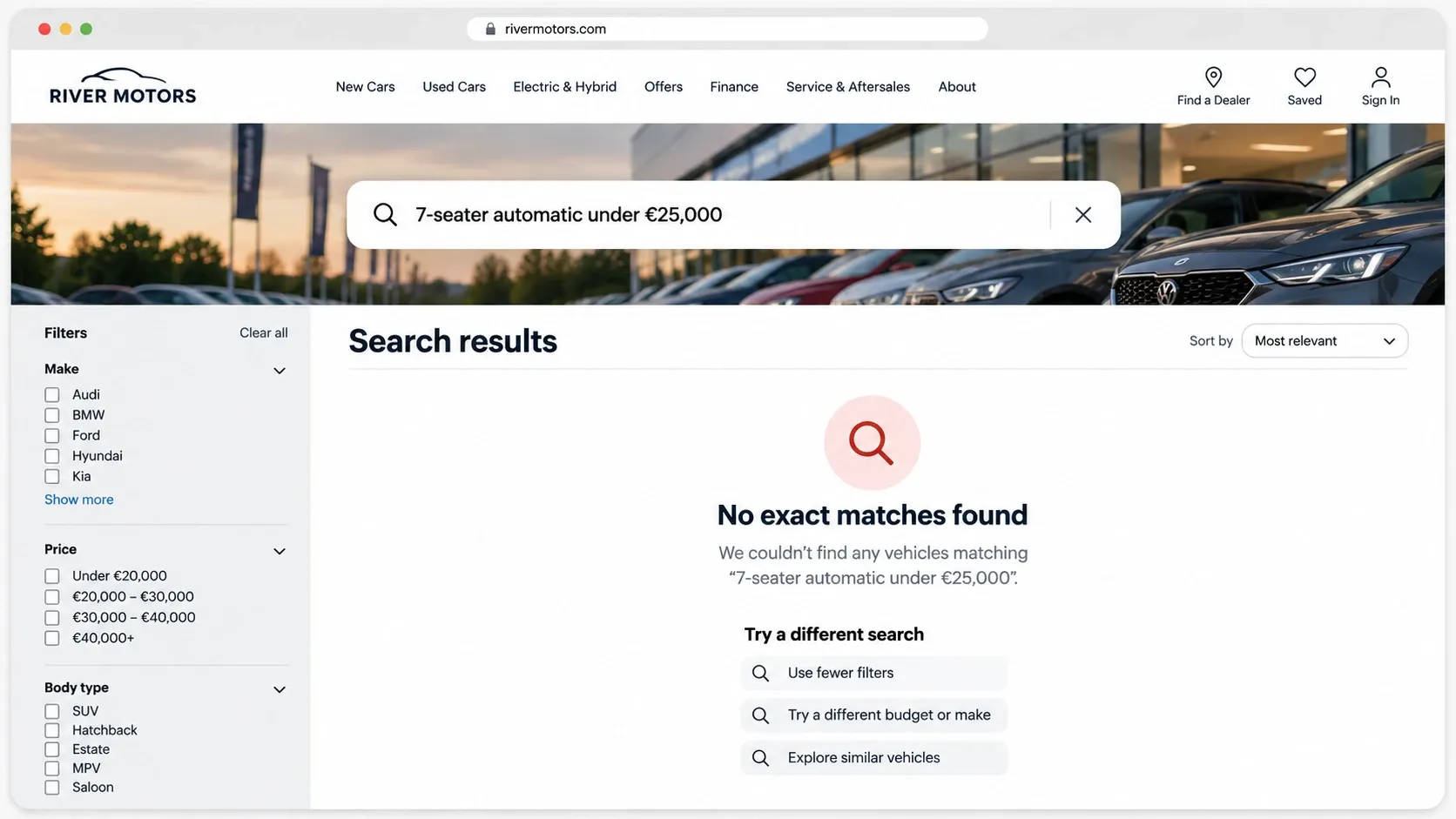
Traditional dealership website search has worked in much the same way for years. Customers choose filters, narrow their options, and browse matching vehicles.
It’s a useful experience when someone already knows exactly what they want. But not every customer starts with a specific make or model in mind.
Buyers think about their needs, not just vehicle specifications
Think about how people describe their next car.
- A parent might want something safe and spacious for school runs and family trips.
- Someone commuting 50 km every day might be looking for low running costs and comfortable driving.
- A first-time electric vehicle buyer might prioritize range, charging convenience, and price without knowing which models meet those requirements.
These are practical needs. They’re not necessarily the same as the technical categories used by vehicle search filters.
Traditional filters expect customers to know what to select
Imagine a customer who wants a comfortable family car with enough space for two child seats and a stroller. Should they choose an SUV, estate, MPV, or hatchback? Which models have enough luggage capacity? Which ones accommodate their requirements without exceeding their budget?
To use traditional filters effectively, they may need to research those questions before searching. That’s an additional step between knowing what they want and finding a suitable vehicle.
Search friction can interrupt the buying journey
There are several common problems with traditional vehicle discovery:
- Too many decisions: Customers must choose multiple specifications before understanding which ones matter.
- Irrelevant results: A broad search may return vehicles that technically match the filters but don’t suit the customer’s needs.
- No results: Overly restrictive filter combinations can leave visitors with an empty results page.
- Repeated searches: Customers may need to remove filters, change categories, or start again to explore alternatives.
None of this means filters are bad. They remain especially useful for buyers with precise requirements. The opportunity is to offer an additional way to search for customers who know the problem they’re trying to solve but not which model solves it.
A simple test for your dealership: Open your website and try searching for a family car under €25,000, an economical commuter car, and an electric vehicle suitable for longer journeys. How easy is it to find relevant options without already knowing the make or model?
How does AI-powered vehicle search work?
You don’t need to understand the technical architecture behind AI to evaluate whether it can improve your dealership website. From the customer’s perspective, the experience can be broken into four steps.
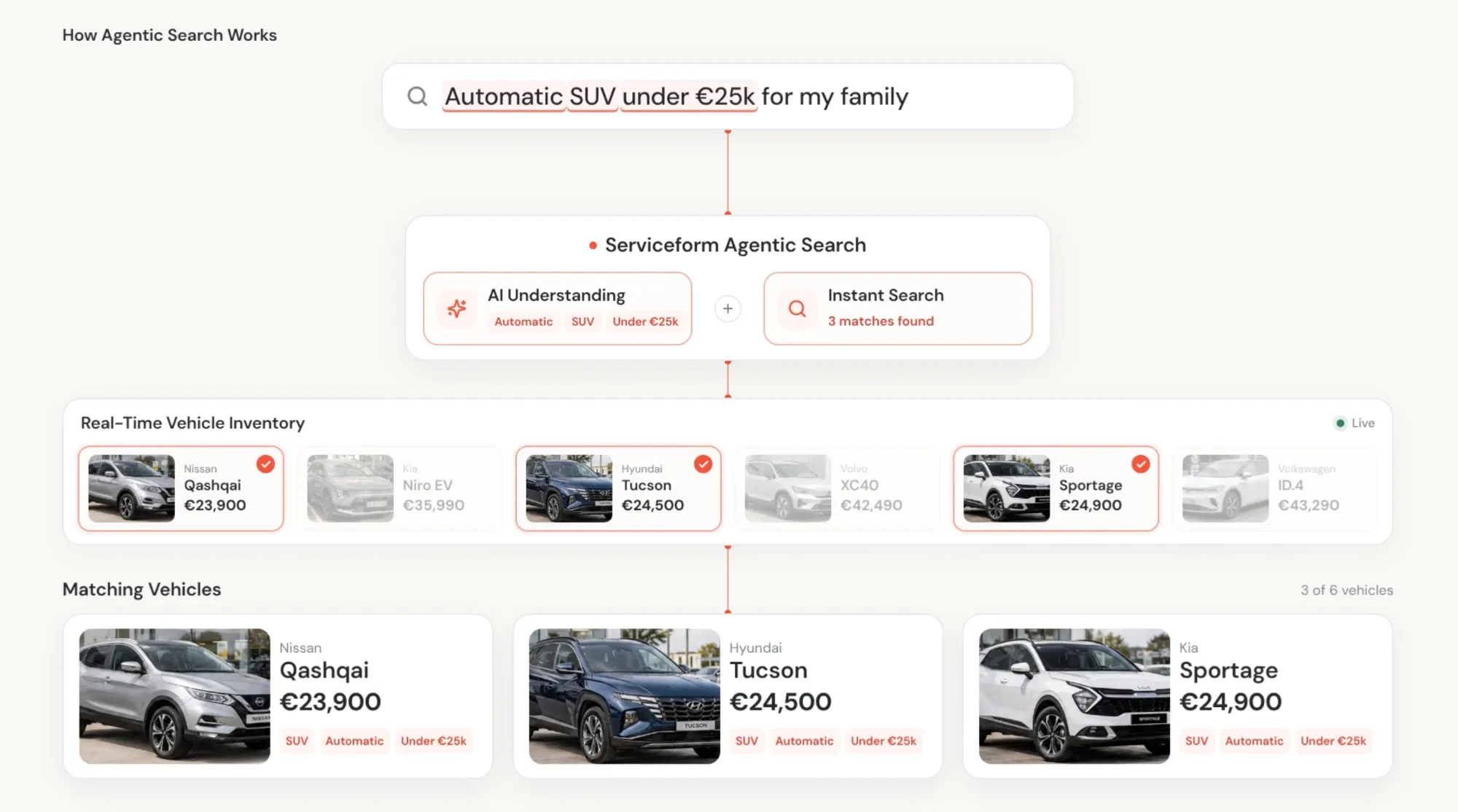
Step 1: The customer describes what they need
A customer enters a request such as:
I need an automatic family SUV under €25,000 with plenty of luggage space.
Instead of selecting individual filters, they describe several requirements together. The search experience may appear in the website header, on the homepage, or within a dedicated vehicle inventory page.
Step 2: AI interprets the customer’s requirements
The system identifies the different elements of the request. For example:
| Customer requirement | Search interpretation |
|---|---|
| Under €25,000 | Maximum price of €25,000 |
| Automatic | Automatic transmission |
| SUV | SUV body type |
| Family vehicle | Family-oriented preferences |
| Plenty of luggage space | Cargo-capacity consideration |
Some requirements, such as price and transmission, can be matched directly to structured vehicle data. Others, such as “family-friendly” or “reliable,” require more interpretation.
For these less precise requirements, the system should use available evidence rather than presenting assumptions as facts.
Step 3: The system searches connected vehicle inventory
The interpreted requirements are matched against the dealership’s available stock. Depending on the solution, this may involve structured filters, AI-based relevance matching, or a combination of both.
The accuracy of this step depends heavily on the vehicle information available. For example, if seating capacity isn’t included in the inventory data, the system may not be able to reliably identify every seven-seater.
Step 4: Relevant vehicles appear in the results
The customer can see suitable vehicles, review prices and specifications, and open individual vehicle listings. They may then refine the search, compare options, enquire about a vehicle, or request a test drive. A good search experience should make these next steps straightforward.
The important distinction is that understanding a request and displaying relevant vehicles should work together. Customers shouldn’t need to complete a lengthy AI conversation before seeing what you have in stock.
Example: Finding the right family SUV using AI search
Let’s look at a realistic customer search. A customer visits a dealership website and enters:
I need a reliable automatic SUV under €25,000 for my family of five and our dog.
This request contains both specific and less defined requirements. The price limit, transmission, and vehicle type are relatively straightforward. But what about reliability? Or enough space for a family and a dog?
What the AI search should understand
The system can identify the customer’s requirements and use the dealership’s inventory data to find vehicles that fit. A useful results page would prioritize:
- Automatic SUVs priced at or below €25,000.
- Vehicles currently available in the dealership’s inventory.
- Models with relevant family and cargo-space characteristics, where supported by the data.
- Clear information about price, mileage, equipment, and specifications.
- Easy access to vehicle details and enquiries.
It might also offer helpful explanations about why particular vehicles could be worth considering.
But there’s an important distinction between finding matching vehicles and helping someone choose the best one. Showing 22 SUVs that match the search doesn’t necessarily make the decision easier. A customer may still need help understanding differences in running costs, interior space, equipment, or suitability. That’s where additional AI guidance or a dealership sales advisor can add value.
What if the dealership doesn’t have an exact match?
Suppose there are no automatic SUVs available below €25,000. A poor experience simply displays “No results.”
A better experience could explain that no exact matches are available and offer alternatives, such as:
- Automatic SUVs slightly above the requested budget.
- Suitable estate cars or other body types within budget.
- An option to adjust the requirements.
- A way to contact the dealership for further assistance.
These should be clearly identified as alternatives, not presented as though they satisfy every original requirement. The aim isn’t to force a result. It’s to help the customer continue their search.
Try AI vehicle search in action
Serviceform’s Agentic Search is designed to help dealership website visitors describe the car they need in natural language and discover relevant inventory without navigating complicated filters.
Rather than describing the experience, you can explore an example yourself: Explore Serviceform’s AI Search for Automotive →
AI search vs traditional vehicle filters vs AI chatbots: What’s the difference?
AI search, traditional vehicle filters, and conversational AI are often discussed as competing approaches. But they solve different customer problems. Understanding those differences makes it easier to choose the right dealership website search software.
Traditional vehicle filters: Best for precise requirements
If a customer wants a particular BMW 3 Series, registered after 2022, with an automatic transmission, filters provide a straightforward way to narrow the inventory. They give customers direct control over the specifications they select.
Their limitation is that shoppers need to understand which criteria to use.
AI-powered vehicle search: Best for needs-based vehicle discovery
AI vehicle search is particularly useful when customers know what they need but haven’t decided which models are suitable. Someone can describe their budget, family situation, driving habits, and preferences in one request. The system interprets those requirements and returns relevant listings.
Its primary purpose is discovery rather than extended conversation.
Conversational AI: Best for guidance and additional assistance
Conversational AI becomes useful when customers have questions or need help making decisions. For example:
- “What’s the difference between these two vehicles?”
- “Would this electric car be suitable for my daily commute?”
- “Can I book a test drive on Saturday?”
An AI assistant can help explain available information and, depending on its capabilities and integrations, guide customers toward an enquiry, booking, or another next step.
Comparison: Which approach works best?
| Feature | Traditional filters | AI vehicle search | Conversational AI |
|---|---|---|---|
| Primary purpose | Narrow inventory | Find relevant vehicles | Guide and assist |
| Customer input | Filters and keywords | Natural-language requests | Questions and conversation |
| Immediate vehicle results | Yes | Core experience | Depends on setup |
| Advice and explanations | Limited | Varies by solution | Core capability |
| Best suited for | Specific requirements | Needs-based discovery | Questions and decision support |
The right choice depends on what the customer wants to accomplish.
- If they want to find something, prioritize search.
- If they want to understand something, provide guidance.
- If they’re ready to take action, make it easy to enquire or book.
For many dealerships, these approaches can complement one another rather than replace each other.
Seven features to look for when choosing AI car search software
Not every AI search solution works in the same way. Some focus on understanding natural-language requests. Others combine search with recommendations, customer assistance, and conversion tools. When evaluating AI car search software, focus on how well it supports real customer needs.
1. Natural-language vehicle understanding
Can customers search using everyday language, or must they still know specific vehicle categories? Test realistic requests involving family size, commuting, budget, driving preferences, and vehicle features. A useful solution should identify multiple requirements without losing important details.
2. Accurate and frequently updated inventory integration
Your search experience needs to reflect the vehicles your dealership actually has available. Ask how the software connects to your inventory, how frequently data is refreshed, and how it handles vehicles that have been sold or removed.
Showing an unavailable vehicle creates a frustrating customer experience, regardless of how intelligent the search appears.
3. Relevant matching and recommendations
A search solution should do more than return every vehicle loosely related to a request. It should prioritize relevant matches and, where supported, help customers understand why those vehicles might fit their needs.
However, don’t confuse search relevance with personalized advice. Finding 22 matching vehicles is not necessarily the same as helping a customer choose one. If decision support matters to your dealership, evaluate it as a separate capability.
4. Useful alternatives when no exact match exists
What happens when a customer searches for something that isn’t currently available? Look for a solution that can handle this situation constructively. Depending on its capabilities, it might suggest nearby alternatives, let the customer adjust their search, or offer additional assistance.
Importantly, alternatives should never be confused with exact matches.
5. Flexible search placement
AI search doesn’t have to live on a separate page. Possible placements include a homepage search section, a search field in the header, an inventory search page, or a search overlay.
The best location depends on how customers navigate your website. For example, a prominent homepage search may help visitors begin exploring, while search within the stock page may suit shoppers actively comparing vehicles.
6. Configurable search behavior
Consider how the system handles repeated searches. If someone searches for an automatic SUV and then asks for one under €20,000, should the system retain the previous requirements? What if their next query is for an electric city car instead?
Some customers want a search that remembers earlier requirements. Others prefer every search to start fresh. Neither approach is universally correct. The right behavior depends on customer expectations and interface design. Ask whether the provider supports the behavior your dealership needs.
7. Analytics and conversion visibility
Understanding what customers search for can be as valuable as improving the search experience itself. Look for reporting that helps answer questions such as:
- What are customers searching for most often?
- Which queries produce few or no results?
- Which results attract clicks?
- Are search users progressing toward enquiries or test drives?
- Can searches be connected to qualified leads and sales opportunities?
Not all providers offer the same reporting or attribution capabilities. Ask for a demonstration of the reports currently available rather than relying on a feature list.
Why vehicle inventory data quality matters for AI search
One of the most important lessons from implementing AI-powered search is that the quality of the results depends partly on the quality of the vehicle data. AI can interpret complex customer requests, but that doesn’t mean it can reliably fill every gap in your inventory information.
AI search needs accurate vehicle attributes
Imagine someone searching for a seven-seater under €30,000. The AI may correctly identify the two key requirements: seating capacity and budget. But the inventory data must contain reliable information to determine which vehicles meet those criteria.
A practical example from Serviceform’s implementation work illustrates this challenge. The team needed to make vehicles searchable by seating capacity. However, the supplied inventory feed didn’t contain the relevant seat-count information. Without that information, the system couldn’t confidently determine which vehicles met the seven-seater requirement.
This wasn’t a problem with understanding the customer’s question. It was a limitation in the underlying data.
Can AI fix missing vehicle data?
AI can sometimes help identify, standardize, or map information from different sources. For example, it may help organize inconsistently formatted vehicle descriptions into searchable attributes.
But there’s a difference between extracting information that exists and inventing information that doesn’t. If an important specification is missing, it should be obtained from a reliable source or treated as unknown.
Which inventory fields should dealerships review?
Before introducing AI search, review whether your inventory contains the information customers commonly need. Important fields include:
- Vehicle make, model, variant, and year.
- Price, mileage, and availability.
- Transmission, fuel type, and body style.
- Seating capacity and practical specifications.
- Equipment, features, and vehicle descriptions.
- Reliable identifiers and links to vehicle detail pages.
Not every dealership needs every possible field. But if customers regularly search by seating capacity, range, or equipment, those attributes need to be consistently available.
Before buying AI search software, check whether your existing vehicle data can answer the questions your customers are likely to ask.
How to implement AI search on your existing dealership website
Introducing automotive AI search doesn’t necessarily mean replacing your website or rebuilding your vehicle inventory system. In many cases, the first step is understanding which data sources and website integrations you already have.
Start with your existing vehicle inventory feed
Your dealership may already maintain structured vehicle information for its website, advertising, or product catalogs. In Serviceform’s development work, for example, an existing Facebook catalog feed was explored as a source for vehicle search. Other structured inventory feeds or files may also be suitable, depending on the software and the information they contain.
The important question is whether the feed provides accurate, complete, and regularly updated data. A one-time file upload may support an initial demonstration, but a live dealership search experience needs a reliable process for keeping stock information current.
Check data mapping and integration requirements
The next step is making sure vehicle fields are correctly understood. For example, your inventory might use different labels for automatic transmission or electric vehicles. The search solution needs to map these fields consistently so customers receive accurate results.
You should also confirm how the search interface integrates with your website and what technical support is required.
Choose the right search placement
Consider where customers would benefit most from AI search. A homepage search field makes the experience visible immediately. A header search makes it accessible across multiple pages. A dedicated inventory search page provides more space for results and filtering. There’s no single placement that’s right for every dealership.
Test before launching
Before publishing, run a set of realistic searches against your own inventory. Test precise model requests, lifestyle-based queries, missing specifications, sold vehicles, and situations with no exact matches. Pay particular attention to whether the results respect important requirements such as maximum budget and transmission.
Plan for ongoing maintenance
Inventory feeds change. Vehicle attributes can be incomplete. Website integrations may need adjustments. Ask whether dealership staff can inspect common data problems and manage routine configuration, or whether every change requires a developer. The easier it is to identify and correct issues, the easier the experience will be to maintain.
How much does AI search software cost for car dealerships?
AI dealership search pricing varies by provider, implementation requirements, and the scope of the solution. There isn’t one standard pricing model that applies to every dealership.
Common pricing models
Providers may structure their pricing in different ways:
- Monthly subscriptions: A recurring fee for access to the software.
- Per-website pricing: Charges based on the number of dealership sites using the solution.
- Usage-based pricing: Fees influenced by search volume or other usage measures.
- Enterprise agreements: Custom pricing for dealership groups or larger implementations.
Some providers may combine several of these approaches.
What influences the cost?
Several factors can affect the overall price. These include the number of dealership websites, the size and complexity of the vehicle inventory, integration requirements, customization, and ongoing support. A single dealership with a standardized stock feed may have different requirements from a multi-brand group using several inventory systems.
What should dealerships ask about the total cost?
Don’t compare subscription fees alone. Ask whether the quotation includes initial setup, inventory integration, data updates, website implementation, support, and maintenance. You should also understand whether additional charges apply as your search volume, inventory, or website network grows.
The most useful pricing comparison is the total cost of getting a reliable search experience live and maintaining it over time.
How to evaluate AI search providers before making a decision
A polished AI demo can look impressive. But generating a convincing response to a few prepared questions isn’t the same as delivering accurate vehicle search on a live dealership website. The best way to evaluate a provider is to see how the technology performs against your actual inventory and realistic customer requests.
Ten questions to ask an AI vehicle search provider
- Natural-language understanding: Can shoppers describe their needs without selecting technical vehicle filters?
- Inventory compatibility: Can the solution use our existing vehicle feed?
- Inventory updates: How frequently are vehicle prices, stock, and availability synchronized?
- Missing information: What happens when important specifications aren’t included in our data?
- No-result handling: Can the system offer useful, clearly identified alternatives?
- Search experience: Can customers see relevant vehicles immediately without starting a conversation?
- Website integration: Can the solution work within our existing dealership website?
- Configuration: Can we control search placement, appearance, and relevant search behavior?
- Measurement: What analytics, lead attribution, and reporting capabilities are available today?
- Real-world testing: Can we try the solution with our actual vehicle inventory before committing?
Why a personalized inventory demo matters
A generic demo tells you what the software is designed to do. A demonstration using your own stock tells you much more about whether it can work for your business.
Ask shortlisted providers to run the same searches across your inventory. Include a combination of specific vehicle requests and broader lifestyle-based questions. Look closely at:
- Relevance: Do the vehicles genuinely match the customer’s requirements?
- Accuracy: Are prices, specifications, and availability correct?
- Usability: Can someone understand the results and explore vehicles easily?
- Speed: Do results appear quickly enough to support a smooth shopping experience?
- Next steps: Can the customer move from a suitable vehicle to an enquiry or test-drive request without unnecessary friction?
If the solution struggles with missing data or complex requests, it’s better to discover those limitations during a demo than after implementation.
See how Serviceform’s Agentic Search could work with your dealership’s inventory →
How can dealerships measure the ROI of AI search?
The commercial reason to improve dealership website search is straightforward: help more visitors discover relevant vehicles and take the next step toward buying. But it’s important to distinguish a better search experience from a proven increase in sales.
An AI-powered search interface might improve vehicle discovery without necessarily producing more qualified enquiries. That’s why measurement should cover three separate areas.
1. Measure search quality first
Start by understanding whether the technology works reliably. Useful measures include:
- Relevance of returned vehicles.
- Accuracy and freshness of inventory information.
- Percentage of searches with no exact matches.
- Frequency of incorrect or unavailable listings appearing.
These measures help identify whether the search itself needs improvement.
2. Measure how customers engage with search
Next, examine how visitors use the experience. Track the number of searches, results clicked, vehicle detail pages visited, and follow-up searches.
For example, if customers frequently search for family SUVs but rarely open the results, the issue could be relevance, presentation, or a mismatch between customer demand and available stock. These insights can inform website improvements and inventory decisions.
3. Connect search activity to commercial outcomes
Where your analytics and CRM integrations support it, examine whether AI search contributes to:
- More vehicle enquiries.
- More test-drive requests.
- More qualified leads.
- More sales opportunities.
- Additional vehicle sales.
For a more meaningful ROI calculation, estimate the incremental gross profit attributable to AI search, then compare it with software and implementation costs.
The challenge is attribution. A customer might use AI search, visit several vehicle pages, return days later, and then submit an enquiry. Connecting that journey to a sale requires the right analytics and CRM tracking. Don’t assume every provider offers complete search-to-sale attribution.
A useful ROI evaluation separates search quality, visitor engagement, and verified commercial results. If possible, compare the new search experience against a baseline or a comparable group of visitors rather than attributing every subsequent enquiry to the technology.
Frequently asked questions about AI search for dealerships
What is AI-powered vehicle search?
AI-powered vehicle search is technology that interprets natural-language customer requests and matches them with relevant vehicles from a dealership’s inventory. It allows shoppers to search using their needs, budget, and preferences instead of relying only on keywords and predefined filters.
Can AI search work with my existing dealership website?
In many cases, yes. AI search solutions can be integrated into existing websites, depending on the provider and website setup. You’ll need to confirm compatibility with your inventory feed, website technology, and preferred search placement.
Do I need to replace my vehicle inventory management system?
Not necessarily. Some AI search solutions can work with existing inventory feeds or structured catalogs. The key is whether your current system can provide accurate vehicle information and sufficiently frequent updates.
How is AI search different from an automotive chatbot?
AI search primarily helps customers discover relevant vehicles and view listings. An automotive chatbot typically focuses on answering questions, providing guidance, and assisting with enquiries or other actions. Some solutions combine both experiences.
Can AI search recommend vehicles based on lifestyle requirements?
Yes, depending on the solution and available inventory information. AI can interpret requests involving family size, commuting, budget, driving preferences, and practical needs. However, recommendations should be based on reliable vehicle data rather than unsupported assumptions.
What happens if a dealership doesn’t have the car a customer searches for?
A well-designed search experience can explain that no exact match is available and, where supported, suggest alternative vehicles, allow customers to adjust their requirements, or direct them toward additional assistance.
How much does AI car search software cost?
Pricing depends on the provider, number of websites, inventory requirements, integrations, and support. Some providers use monthly subscriptions, while others offer usage-based or custom enterprise pricing. Request a quotation that includes both setup and ongoing costs.
How do I know if AI search is right for my dealership?
Start by looking at how easily customers can discover vehicles on your current website. If visitors need to navigate many filters, or you carry a broad inventory that can be difficult to explore, AI search may be worth testing. The most reliable evaluation is a demonstration using your own inventory and realistic customer questions.
Conclusion: Make it easier for customers to find the car they actually need
Your customers don’t always start their car-buying journey knowing which make, model, or specifications they need. They might simply want a reliable family SUV, an affordable electric car, or something comfortable for their daily commute.
Traditional vehicle filters remain valuable, especially for customers with precise requirements. But AI-powered search offers another way to connect customer needs with available stock.
The right solution should do more than understand natural-language requests. It should deliver accurate inventory results, make suitable vehicles easy to explore, and provide a clear path toward enquiries or test-drive bookings. And before choosing a provider, test how well it works with your actual vehicle data.
See AI-powered vehicle search working with your dealership’s inventory. Explore Serviceform Agentic Search and request a personalized demo.